What It Takes to Build Market Infrastructure That Supports Credit for Women at Scale

In Focus
In Focus is a new FinDev series in which practitioners in inclusive finance share their experience and analysis of the issues they’re grappling with and the lessons they’re learning.
Author: Sucharita Mukherjee, Kaleidofin
Read time: 10 minutes
Between 2009 and 2023, the number of women using microfinance in India increased from 4 million to 60 million, according to the Microfinance Industry Network (MFIN), a self-regulatory organization and industry association for microfinance institutions in India. Over the same period, Reserve Bank of India (RBI) reports and MFIN data show that the interest rate borrowers paid fell from 37% to 24%. At the same time, the credit-risk premium, the additional return investors required to cover the risk of not being repaid, fell from 12% to 5%. This additional return is measured against what investors could earn on a safe investment such as government bonds. This growth was supported in part by the development of local-currency debt markets and specialist intermediaries that connected large financial institutions with non-bank lenders, also called originators. These are typically last-mile, non-deposit-taking companies reaching out and providing finance directly to small businesses and individual customers.
India's microfinance expansion, 2009 - 2023

Source: MFIN, RBI.
Building risk and market infrastructure: four problems India had to solve
The development of India’s inclusive-finance debt markets required connecting high-quality originators, which could reach underserved borrowers, with banks and institutional investors that could provide wholesale financing to these originators at scale. This meant addressing four interconnected challenges:
- Strengthening the capacity of originators. Many originators – most of them microfinance institutions at the time – had established networks and relationships with borrowers but often lacked the funding and operational capacity to grow. The Small Industries Development Bank of India (SIDBI) – a public development bank supporting small businesses – provided early-stage equity and funding for technology that helped microfinance institutions build their operating capacity. This helped these originators build the systems and track record that banks and institutional investors would later look for when deciding whom to lend to.
- Expanding access to bank financing. Originators also needed more reliable sources of debt capital to serve growing numbers of borrowers. ICICI Bank, a major domestic commercial bank, expanded wholesale lending through its partnership-lending model, providing financing to originators that lent directly to customers. This allowed bank funding to reach a much larger number of underserved borrowers.
- Attracting a wider range of institutional investors. Beyond bank financing, originators needed ways to demonstrate the quality of their loan portfolios and attract other sources of capital. Northern Arc, a specialist financial intermediary, helped address this challenge by assessing originators and structuring wholesale financing arrangements, including securitizations, that enabled institutional investors to finance originators they would not otherwise have reached. Today, financing to these originators through securitization, direct assignment, co-lending, business correspondent and other debt capital markets arrangements is estimated at more than $10 billion, based on our analysis of CRISIL data and the Bharat Microfinance Report 2025.
- Improving the assessment of individual borrowers. Traditional group-based microfinance did not always provide the information needed to assess borrowers individually and offer loans suited to their businesses. Kaleidofin, a financial technology platform, developed data-driven credit scores, called ki scores which helped originators to do this, enabling women entrepreneurs to move from traditional group-based microfinance to loans better suited to their businesses. These microentrepreneur loans could then be securitized, giving originators access to institutional debt capital to grow tailored microentrepreneur loan portfolios.
What the data shows about lending to women at scale
Our approach at Kaleidofin combines three capabilities: ki score to assess creditworthiness, including for borrowers with limited credit histories; ki monitor to support portfolio oversight and early warnings on customer and small business loan portfolios; and ki catalyst to support portfolio selection, structuring and investor-facing monitoring at the level of the wholesale financing portfolio.
Together, these tools help translate dispersed borrower and loan data into actionable risk information for both originators and debt investors. This can help originators develop more suitable loan products for customers and access wholesale financing arrangements, including securitization. Our data shows that the Kaleidofin scoring system has been used to assess over $13 billion in credit from 2020 to 2026, of which over 90% has been disbursed to individually underwritten women entrepreneurs. This demonstrates how originators can assess individual women borrowers at scale, generating the granular loan-level data and performance track records that investors need to evaluate risk and finance these portfolios. In doing so, risk infrastructure can help bridge the gap between last-mile lending and access to wholesale debt capital.
As financing expanded, originators built longer track records of lending to women entrepreneurs. Our portfolio data from 2020 to 2026 show reported loan losses consistently below 4% on loans assessed using its risk infrastructure.
This performance provides evidence that individual borrowers can be underwritten at scale and that portfolios serving women entrepreneurs can achieve consistently strong credit outcomes.
Over the longer term, the cost of wholesale financing also declined. Between 2009 and 2023, the credit-risk premium demanded by debt investors and wholesale lenders fell from 12% to 5%, a reduction of 7 percentage points, based on our analysis of Northern Arc and Kaleidofin platform-supported debt capital markets and other wholesale financing arrangements. This trend illustrates how a stronger performance track record can contribute to investor confidence, reduce the perceived risks of lending to this market and improve the terms on which originators access debt capital.
Who builds shared market infrastructure
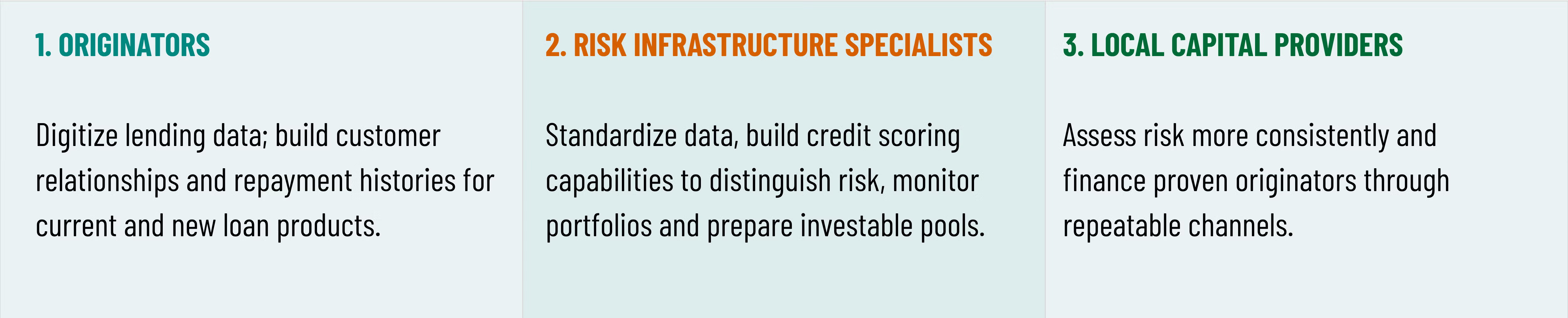
East Africa faces the same barriers India did
During our first two years of work in East Africa, Kaleidofin has encountered many of the same market-development questions that shaped inclusive finance in India. Originators often have inconsistent data and systems, and local banks and institutional debt investors have limited capacity to assess and monitor loan portfolios. As a result, originators have difficulty meeting the information and risk requirements of institutional investors.
Even originators with good repayment records can struggle to attract investment because of the high costs of assessing risk and structuring smaller financing transactions. Shared infrastructure can help address these barriers by standardizing data, improving risk assessment and developing financing arrangements that can be used across multiple originators.
In East Africa, we have created such a shared infrastructure through ki Platform PCC, a Mauritius-based structured-finance program designed to help high-quality originators access wholesale financing at lower transaction costs. High legal costs can make smaller transactions uneconomic, so lowering them opens wholesale financing to high-quality originators, whether big or small. Under the Kaleidofin arrangement, legal transaction costs are estimated at less than $50,000 per transaction, or less than 10% of historical costs of executing similar structured finance transactions in East Africa. This is enabled by the structured finance vehicle program, which creates a reusable template for the structure of each transaction and drives the standardization of legal documentation, terms, and reporting.
Early results are encouraging
Between May and October 2026, Kaleidofin structured three debt capital markets transactions, two in local currency and one with an investment-grade rating. These transactions (2 billion Kenyan shillings, about $15 million in total so far) are associated with improved access to livelihoods for 60,000 smallholder farmers. During this period, the Kaleidofin risk platform reported cumulative collections 29% higher than those projected during the structuring of these transactions, with no defaults to date. This signals early success and supports the idea that high-quality assets can be financed successfully and form the foundation of the structured finance market.
These transactions have helped create a new market for securitization in East Africa, connecting local originators to new sources of capital from impact investors and international asset managers, including the IDH Farmfit Fund and Mirova Gigaton. While still limited in scale, they demonstrate how appropriately structured financing and better risk assessment can make originator portfolios investable by institutional capital providers. By establishing a repeatable route from local lending portfolios to wholesale investment, this infrastructure can help build a market for securitization and expand access to local-currency funding for high-quality originators.
A $4 billion goal and what it will take
Our medium-term ambition is to develop a $ 4 billion structured finance and wholesale debt market across Kenya, Uganda, Rwanda and Tanzania. India's experience offers a useful reference point: Its microfinance-only structured finance and wholesale debt market grew from $500 million (INR 5,000 crores) in 2009 to $16 billion (INR 160,000 crores) in 2025, driven by the development of risk and market infrastructure that infused confidence among bank lenders and other institutional debt investors.
East Africa also has considerable potential. A Kaleidofin market mapping, using country-level regulatory and industry association data, found more than 1,000 originators across Kenya, Uganda, Rwanda and Tanzania, many of them serving underserved women. Kaleidofin also estimates that the informal sector, where much of the underserved population of these four countries earns its livelihood, accounts for around $100 billion of combined annual GDP. This rough estimate combines 2023 World Bank GDP data for Kenya, Uganda, Rwanda, and Tanzania, with national and ISS African Futures estimates of the informal economy’s share in each country.
However, reaching the $4 billion ambition will require building a pipeline of eligible assets, developing financing structures that can be reused and adapted across transactions, strengthening originator data and reporting, establishing appropriate legal and regulatory frameworks, and deepening domestic institutional-investor participation.
The goal is to build a market capable of mobilizing local-currency capital for originators serving women entrepreneurs, small businesses and smallholder farmers.
What development-focused investors can do
- Fund shared infrastructure. Support the development of common data systems, specialist underwriting tools, portfolio monitoring, reporting standards and the operational capacity that many originators may be unable to develop efficiently on their own.
- Help high-quality originators become ready for institutional financing. Technical assistance can help lenders clean and standardize data, strengthen collections, prepare portfolios, meet reporting requirements and build a track record. These costs are often too commercial for grant programs and too early for commercial investors.
- Use targeted risk-sharing to build investor participation. Guarantees, mezzanine investments in securitization transactions and other forms of credit enhancement can reduce barriers to investment by reducing risk exposure and therefore help investors invest in unfamiliar asset classes with greater confidence. These arrangements should be transparently priced and structured, where possible, on arm’s-length terms to generate performance evidence and support greater commercial participation over time.
- Coordinate the ecosystem around local-currency finance. Engage originators, banks, pension funds, insurers, rating agencies, regulators and specialist intermediaries in a coordinated market-development effort. Alongside regulatory permission, the market needs investable instruments, credible performance data and time to build investor familiarity and confidence.
Measure who benefits, not only how much capital moves
The objective is a durable financial ecosystem in which responsible, high-quality originators, irrespective of size, can provide suitable productive credit to more women entrepreneurs, while domestic banks and institutional investors finance those originators on transparent, risk-adjusted terms. Success should be measured not only by the amount of capital mobilized and the terms on which originators receive it, but also by who ultimately benefits, whether women gain access to more appropriate products and whether this translates into improvements in their economic opportunities. Loan pricing and portfolio quality are also important measures of whether this expansion is sustainable.
India’s experience shows how financial-market development can support women’s economic mobility. When underwriting is more consistent, portfolio performance is visible and funding channels are repeatable, originators can access a broader range of capital and extend credit to borrowers whose potential may not be reflected in conventional credit assessment.
Latest from Our Blog
View all blog posts
Is East Africa Ready for Open Finance?
Let’s Talk About Microcredit: Why Is the Story So Complicated?