Around the world, 1.3 billion people remain unbanked and women lag behind men in terms of access to formal accounts, credit, and savings products. FinEquity, a community of practice to empower women through financial inclusion, is convened by CGAP. It provides facilitated platforms to share experiences, identify key challenges, document and discuss emerging good practices, and solve common problems associated with increasing equitable access to and use of a broad range of financial services. Learn More
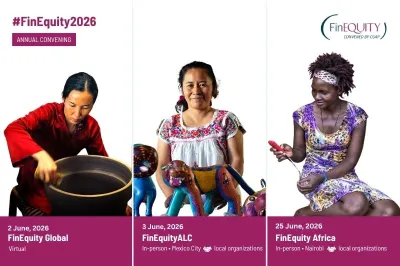
The 2026 event brought together financial service providers, policymakers, regulators, funders, and other practitioners from around the world around a shared and urgent question: how do we keep gender on the agenda when funding is tight? You can now watch the full recording.
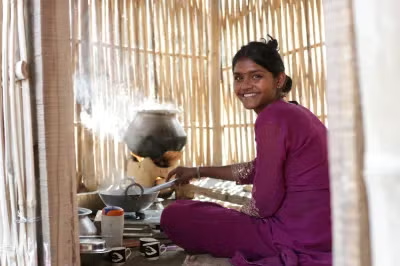
Findings from India and Nepal show how inclusive housing finance can strengthen women’s agency and livelihoods.
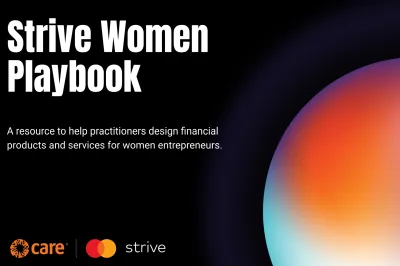
A practical resource to help practitioners design financial products and services for women entrepreneurs using women‑centered design.
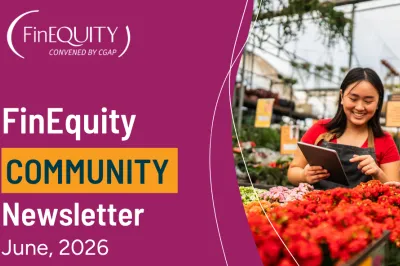
FinEquity Community Newsletter | June 2026
Check Out Our Latest FinEquity Newsletter!
Catch up on Day One of the FinEquity Annual Convening 2026. Explore all the resources inside!

FinEquity Independent Evaluation Report
We are excited to share the results of FinEquity’s Independent Evaluation! The findings highlight the critical role of FinEquity in keeping gender on the agenda, creating a trusted, inclusive space where diverse stakeholders can connect, learn, and collaborate. Two-thirds of those interviewed and surveyed valued FinEquity for learning and knowledge exchange, while 40% found direct impacts on their work in designing strategies and solutions and identifying partners.

Can mentorship be scaled without losing its human touch? Strive Mexico tested what works for women entrepreneurs with diverse digital capabilities.
Latest Publications
The findings in this learning brief draw on the Strive Women Midline Survey, conducted by 60 Decibels, which measured how women micro and small enterprise owners across Pakistan, Vietnam, and Peru experience and respond to digital financial risk and fraud.
The paper summarizes Financial Sector Deepening Uganda (FSDU)'s research on how young Ugandan women move from school to work, from legal minority to full citizenship, and from ward to caregiver, specifically by accessing and using financial services.
This case study examines Kenya’s policy, regulatory and institutional approaches to advancing women’s financial inclusion, with a focus on improving access to finance for women-owned and women-led MSMEs (WMSMEs).